
Most investors don’t lose money because they picked the wrong deal.
They lose money because they applied the wrong asset management strategy for the asset class, business plan, and equity patience behind it—without adjusting for the environment around them.
Asset management is not a blanket playbook—it’s a precision discipline.
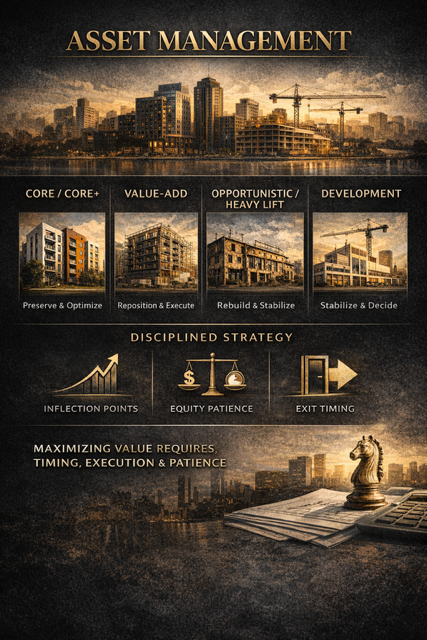
Asset Class Strategy Isn’t Interchangeable
Core / Core+ (Stabilized Assets)
This is a defensive, yield-preservation strategy.Focus:
- Expense discipline without degrading resident experience
- Incremental NOI growth (fees, renewals, ancillary income)
- Long-term retention and brand stability
- Capital planning that preserves—not over-enhances—the asset
Execution mistake:
Treating Core like value-add and overspending CapEx for returns that won’t materialize.Value-Add (Moderate Reposition)
This is a timing-sensitive execution strategy.Focus:
- Renovation pacing vs. lease trade-out timing
- Concession strategy and unwind planning
- Revenue management tied to real absorption—not pro forma
- Tight alignment between asset management and operations
Execution mistake:
Pushing rents ahead of market or dragging renovations → both delay stabilization and compress exit value.Opportunistic / Heavy Lift (Distress, Lease-Up, Reposition)
This is a full operational rebuild.Focus:
- On-site leadership and daily execution cadence
- Stabilizing occupancy and collections first
- Strategic CapEx vs. OpEx (stop the bleed, then build)
- Real-time decision making—not backward-looking reporting
Execution mistake:
Managing from a spreadsheet instead of the property.Development (Ground-Up | ~3-Year Horizon)
Development is often underwritten as a high-velocity stabilization → decision point strategy.
Focus:
- Lease-up velocity over vanity rents
- Market-aligned pricing to hit absorption targets
- Tight coordination between construction completion and leasing
- Delivering a clean, proven income story quickly
But here’s the critical fork:
Stabilize → Then Decide
- Push to Sale: Capture value at peak lease-up narrative and forward NOI
- Push to Refi: Hold if debt markets, rate environment, and cash flow durability support it
Execution mistake:
Trying to do both halfway—missing the optimal sale window and not positioning for a strong refinance.Warranty Plays (For Long-Term Holds)
If you’re holding post-development or post-reposition, your strategy shifts from velocity to durability.
Focus:
- Aggressively manage warranty periods (12–24 months)
- Identify and resolve construction defects early—before they become capital events
- Preserve CapEx by forcing accountability back to contractors/developers
- Build a forward capital plan based on true asset condition—not assumptions
Execution mistake:
Letting warranty periods expire passively → turning preventable issues into future CapEx.Threshold Plays Define Outcomes
Every deal hits inflection points—and this is where strategy must shift.
Stabilization Threshold
- Occupancy without quality revenue is a false signal
NOI Plateau
- When growth slows, the question becomes: hold or harvest?
Refi / Sale Window
- Execution + market timing must align—not just your original business plan
Execution mistake:
Holding too long trying to “perfect” the story while market conditions move against you.Equity Patience Defines the Strategy
Your capital stack dictates your flexibility.
Short-Term Equity (3–5 years):
- Speed, clarity, and exit discipline
- No room for operational drag
Long-Term / Patient Equity (7–10+ years):
- Ability to ride cycles
- Focus on income durability and strategic reinvestment
Execution mistake:
Mismatch between hold strategy and equity expectations → forced, suboptimal exits.Macro + Micro Environment Changes Everything
This is where most “textbook” strategies break.
- Interest rates shift your refinance vs. sale decision
- Supply pipelines impact your rent growth assumptions
- Local comp performance dictates your pricing power
- Operational realities (staffing, collections, resident profile) reshape execution
Your strategy should never be static.
It should flex with both macro conditions and micro asset-level truth.Execution mistake:
Running the original underwriting instead of the real-time business.Exit Timing Is an Asset Management Decision
The best asset managers are constantly asking:
- What is the next buyer paying for this income today?
- Are we at peak execution—or still proving the story?
- What risks are forming ahead?
Because:
You don’t maximize value by holding forever.
You maximize value by exiting when execution and market alignment peak.Bottom Line
Asset management isn’t a textbook.
It’s not rigid. It’s not linear. And it’s definitely not one-size-fits-all.
It’s art.
It requires:
- Reading the asset like a living business
- Understanding capital pressure and timing
- Adjusting strategy in real time
- And executing with precision across operations, finance, and market dynamics
The best outcomes don’t come from following a playbook.
They come from having the discipline, vision, and experience to act like a master architect—designing and executing the right strategy for the moment you’re in.
Related posts

Resources to Learn Asset Management
May 29, 2023
Tips to help passive investors, remain passive
June 23, 2023
Asset Management Education – Cohort 1
August 14, 2023
Technology as an Amenity
September 7, 2023